

What transformations belong to us?
If you’ve been following the adventures of StoryCommons in the last couple of months, you’ll know we’ve been exploring Witch Hare storytelling. We’re aiming to ignite conversation about forgotten folk tales, and imagine in the liminal space between human and hare. The following is a reflection on our first session in Ditchling. Here is some news about our upcoming sessions.
On October 5th, a bright, autumnal Saturday, eight of us gathered in a Story Yurt behind our house to talk with stories of fluidity between leporid and human, hearth and earth, skin and fur.
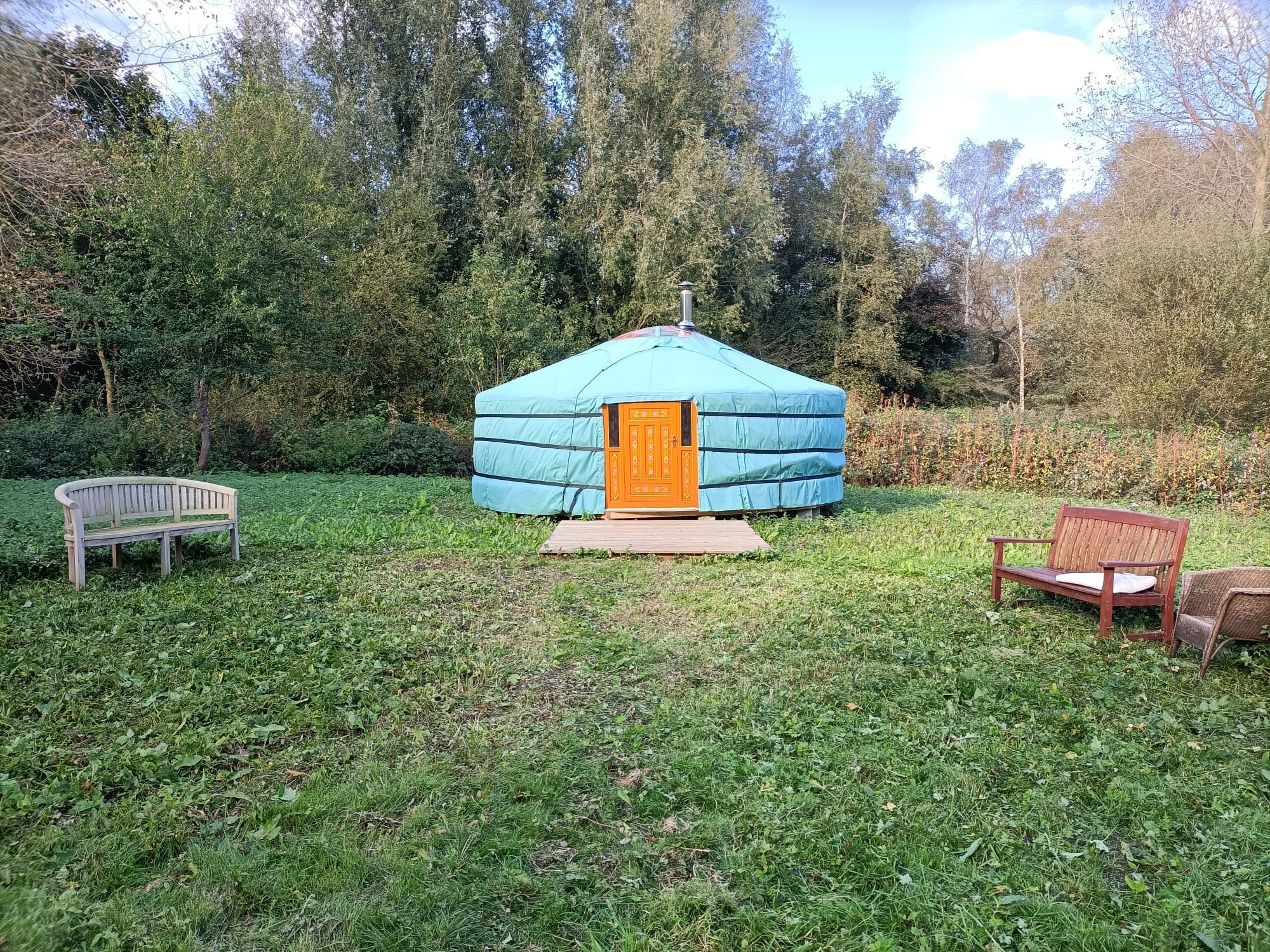
The field was muddy; I had warned people to bring strong boots, and all of us picked our way through, passing nettles tall as our thighs, brambles deep with dead and curling leaves, willow trees with rivulets of wild roots, a hawthorn with a few shining berries. There is a clearing in that field, and in the clearing is a green and orange yurt.
The yurt is still quite young, erected by a team of friends in June. So it feels, and is, community space; and I still feel its fragility, aware of the strange privilege of having a field with a yurt, fearful of tenacities of weather and the possible condemnation of neighbours. I want it to be a wild, collective, communal space, and I am always wondering, what of that is possible? What is safe, and what can be permitted to unfold?
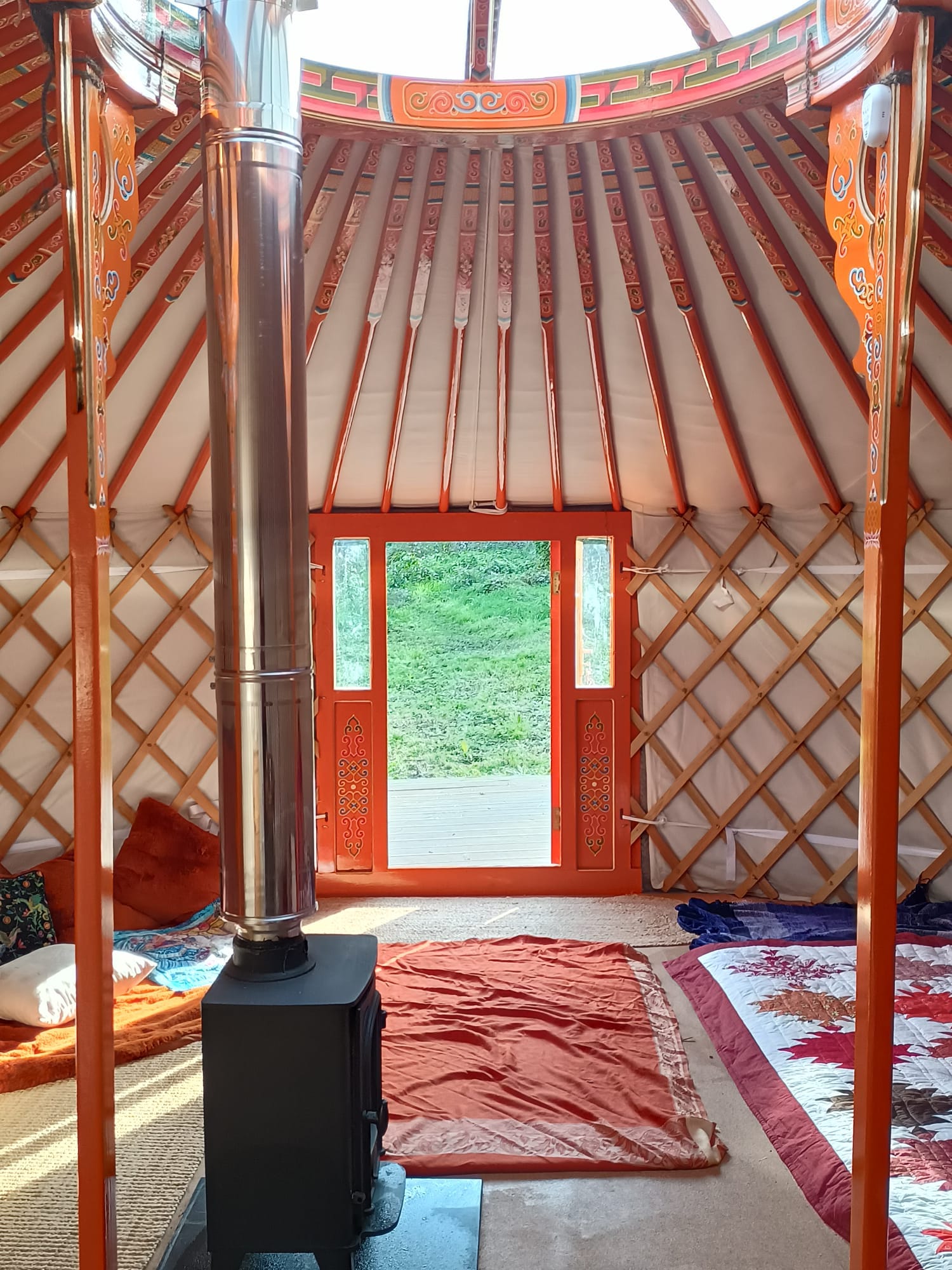
My friend Abi, who has a beautiful, sacred yurt in Hurstpierpoint, is designated fire keeper, knowing, as she does, about the complications of flame and flue. So she lights the new hearth in the damp frosty morning, and it is beautifully warm when we gather together in the space, the sunrise orange poles radiating from the ring of grey sky space at the centre, and inviting us into a space of otherness.
We take our places on the cushions, rugs and mattresses. I am tense, nervous – this is our first session, and bringing it together has been exhausting. The tangles of contemporary communication, social media performance, negotiation and proclamation; the labyrinth we have to work our way through in order to gather together in a yurt and tell stories about witch hares.
What we do, in StoryCommons, is invite stories to exist in company, because we find that stories, in company, have more dimensions than stories alone. Ditchling itself is a space of witch hare legends, but the legends that have been written down are those of witch identification, capture, persecution. Embedded in Sussex and across the UK are threads and fragments of other stories, leaping, twisting, transforming stories of humanfolk and wild hares. The Witch Hare project is about inviting the stories into conversation with each other to see what will happen next.
We offer our names into the circle, and I open the space by remembering Saint Melangell, the Irish princess who refused to marry and ended up in a Welsh valley. One day she protects a hunted hare in her skirts. The prince of that land is so astounded by her power and magnificence that he offers the whole valley up to her as a space of wild refuge. Still today, in the valley of Pennant Melangell, is a church dedicated to the saint and to her hares.
I speak about some other witch hares fragments, and then move on to a sharing of the fragment from Sussex known as the Heathfield hare.
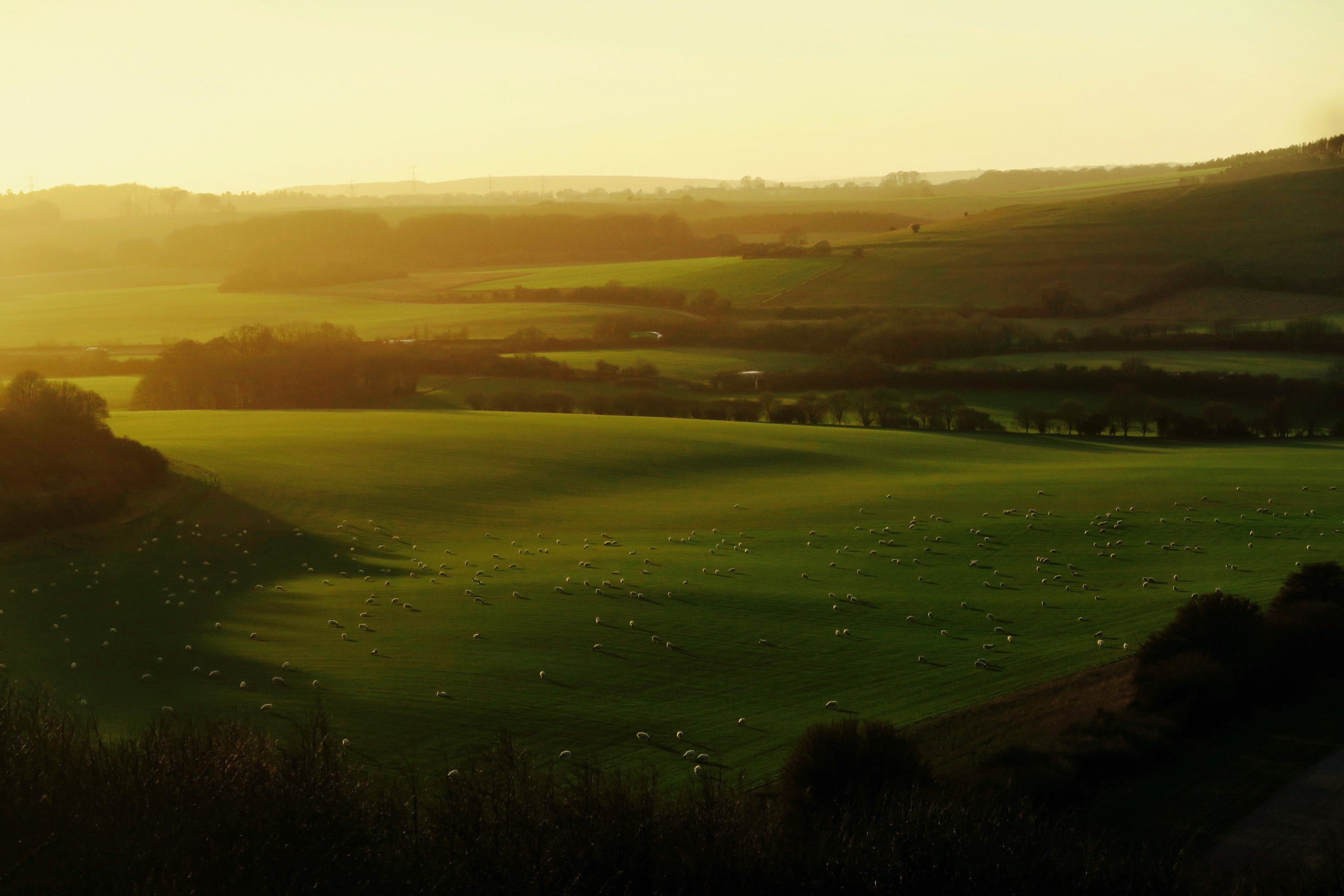
Since writing the article in which I shared the story, I’ve been working with this tale of a woman waking up outside of time. I work on stories while walking, so, while working with the story last month, I started patterning a loop around the village; from the field of the yurt, past the geese and sheep of the neighbouring farms, across the busy road at the edge of Ditchling, and then up the wide field at the back of Lodge Hill, which is often dotted with fairy rings of field mushrooms. At the top of the hill, crossing the muddy path, over to the wide green slopes dotted with sheep which look over towards the South Downs, and then crossing again, onto the other side, a high hill with a dip in its centre which the archeologists say may once have been a Neolithic fort. Down this slope, past the ancient elm tree, bearing grafitti as old as some of its bark, and then back into the village, the church, the duck pond, home.
This weekend I heard the poet and activist lisa luxx speak. She was talking about the fact all poetry is political, even if you don’t mean it to be. If you write a poem about planting a rose tree in your garden, then we know you have a garden, and a rose tree, and the time to plant them. She spoke about the time she spent in Beirut in 2020, helping families effected by the Beirut blast. The tension, for her, between being a poet and being an activist, because when people are dying around you, how can any arrangement of words on a page make a difference? In Beirut, she said, when people are given aid, what is often requested are bags of rice, because of their versatility. Rice can be cooked with, also used as insulation, even to fill mattresses. She began to think, she said, about rice poetry. Can there be poems that are as versatile and useful in the midst of crisis as a bag of rice?
I write this because it is easy to see these witch hare stories as outside of mattering, as the world tears and burns. In writing of the story path I took with the Heathfield Hare, I’m aware of what it means to have the space in which to do this, to live in a place like this. I don’t know if there is anything rice-like about these stories and their tellings; only perhaps, as our attention has been systematically extricated from our bodies and our terrestrial imagination repetitively wrested from its rhythms, it does something to offer imaginings to the gathering dusk of a tiny corner of an island that is struggling to remember its collective responsibilities and its wild self.
And there is politics here, even in the seemingly idyllic landscape of sleeping pigs and hens roosting as night falls. Each time I put up a poster in the village, of a woman dancing in a red dress, proclaiming witch hares, a part of me flinches. Where do Ditchling’s witch legends come from? We know, somewhere lost in the creaky memories of paginated years, something happened to those outsiders who were caught with debilitating limps, with trailing blood, with lameness or difference that untethered them from a robustness of community that should have kept them safe.
So I am careful, when I walk with the story, because I am not sure of the embedded pains that the village still holds, tenderly, within its earth and stones. But I listen, also, because I think that perhaps the village remembers other things. The leap and thud of hock and foot on ground, the taking of a cloak, invisible as a verb, wild change making. Herbs gathered that are in fluid conversation with keeping well. Fire, perhaps, and dancing stars.
As I am walking the path with this story, I also make offerings; a rosehip and a cup of elderberry wine in the dip of the hills, songs sung at dusk when songs are needed. Slowly, the story begins to shift and resonate with the air and the sloping hills. This is a tale in which a woman rides out to market at midnight, and meets a fairy, who is also a hare, and rescues her from the devil with the quickness of her wit. They begin to have names; Ann, the middle-aged woman who accidentally rides to market at midnight, May, the hare-shifting fairy woman who is running from a spectral hunt.
Often I queer the stories I tell, not to make change dependent on my own agenda, but to listen to the other, deeper-than patterns that the story’s written recordings might have erased. In the fragment of the tale as it is written, the fairy offers bounty and blessing to the woman who rode out of time and saved her from the devil’s curse. But I wonder – what if this blessing was not so much of bounty in the future but of bliss in the moment? And what if it was a more collaborative, somatic moment of safety that the two of them offer each other?
It was, and it wasn’t, as the Slavic opening to wonder tales goes. As I and the story walk the hill, the two women come home to Ann’s house, into her bed and meet each other in sweetness and rugged stars. But in the grey hours before dawn it gets very cold, and something is circling the house. Is terror so easily outrun? Is such sweetness possible, when our bodies remember being hunted? What transformations are we allowed to have?
In this second tipping point of the story, it becomes the house itself which makes the difference. Or rather, the power of remembering the malleable, durable, resonant matter which breathes out time and grows the roots of space. Keep the house, May says to Ann. Just that. Just like we, in the orange yurt, are co-creating space and time with the fire, the rugs and sunrise poles that exist both here and in the plains of primitive imagination.
After the story, people share moments that moved them, and as the tale has unfolded in the presence of the hills, so the little stone house of Ann unfolds in the witnessing of story. It’s the stone, the mirror and the iron pot they use to remember safety that resonate around the circle; alongside the gentle company they keep with each other, and the bravery of Ann in telling the spectral hunt to ride on by.
For our second story, Amelia Ace Armande tells the tale of Duffy and the Devil, an incredible Rumpelstiltskin variant from Cornwall. In this tale Duffy hates to spin – she’d rather sing and dance in the mill with her friends. When her mother berates her in the street, however, she loudly proclaims otherwise. Hearing her boasts, the local squire brings her to his house and asks her to get to work. Swiftly, courageously, she does a deal with a devil who emerges from the raw wool, that for three years her house will be filled with exquisite embroidery and her squire dressed in as much finery as he could ever wish for. And after three years, when she’s about to be taken down to Hell, it’s not an accidental rider who brings her the name of the imp from the wool. It’s Old Bet, the crone down at the mill. Old Bet goes out that night and becomes a hare, leading the squire and his hunt on, on, through cracking twigs and autumn leaves to a coven of dancing witches, and there in the centre, the devil is singing his own name.
When we are thinking with this story, we keep coming round to the moment when Duffy tells Old Bet the deal she has made – the importance of words between women, and of friendships, so often obliterated as fairy tales were passed down through the factory line of patriarchal systems. We talk about the dancing, and the singing, which run through the story like an unspoken pulse. And we speak about the moment Old Bet puts on her yellow cloak, and walks out to wait for the squire to ride down the road. When she hears him coming, she turns into a hare. Just like that, with no complications, curses, agonies or incantations. It’s a thing she’s being doing all her life, and it’s a thing she’s going to do again to save this young women from a deal she no longer wants. Like the fall of a twig, like the snap of her fingers, like the picking of a nettle that will infuse into a tea of blood strength.
What transformations are we allowed to have?
The third story is told by Abbie Simmonds: not specifically a witch hare story, but a story of ancient transformation, the tale of Ceridwen and Taliesin, a myth to bring the old incantations into our witch hare space. As Abbie tells the tale, she weaves it through with the dappling light of transformational alchemy. When Gwion Bach, the child who is stirring the cauldron of inspiration, puts his thumb in his mouth, he does it to quell the burning, but takes the three drops of wisdom that the enchantress Ceridwen was brewing for her son.
And Gwion Bach changes, because in all the wisdom that is now drenching him, he knows how. He changes, first of all to hare, but Ceridwen pursues him as a greyhound, then to salmon, but she pursues him as an otter, then to wren, but she pursues him as an eagle, and then to grain of corn, and she eats him as a black hen, and gives birth to him, nine months later. She tries to kill the child she has birthed, but she cannot kill him, and she sets him out on a coracle on the waves, and he changes again, in a leather bag, until the bag is a caught in a salmon net. A young man finds him, and is struck by his shining brow, and the child becomes Taliesin, he of the shining brow, an infant who declaims the most beautiful poetry the world has ever heard.
And what of Ceridwen’s story? In the story as it is written, she is enchantress, with craft to protect and bless her children, and also a vengeful, terrifying witch of power. The story is so old, so layered, with layers that exist beneath those written like the dreaming ground. There is hurt, and confusion, and theft, yet also the chase between Ceridwen and Taliesin resonates and transforms, a forgotten and infinitely remembered rite of bardic becoming that happens when we speak words of poetry and song that are also more than us. And now across the world we speak of Ceridwen as Goddess, which the recorded text doesn’t remember, but perhaps our bodies do. What kind of transformations are we allowed to have?
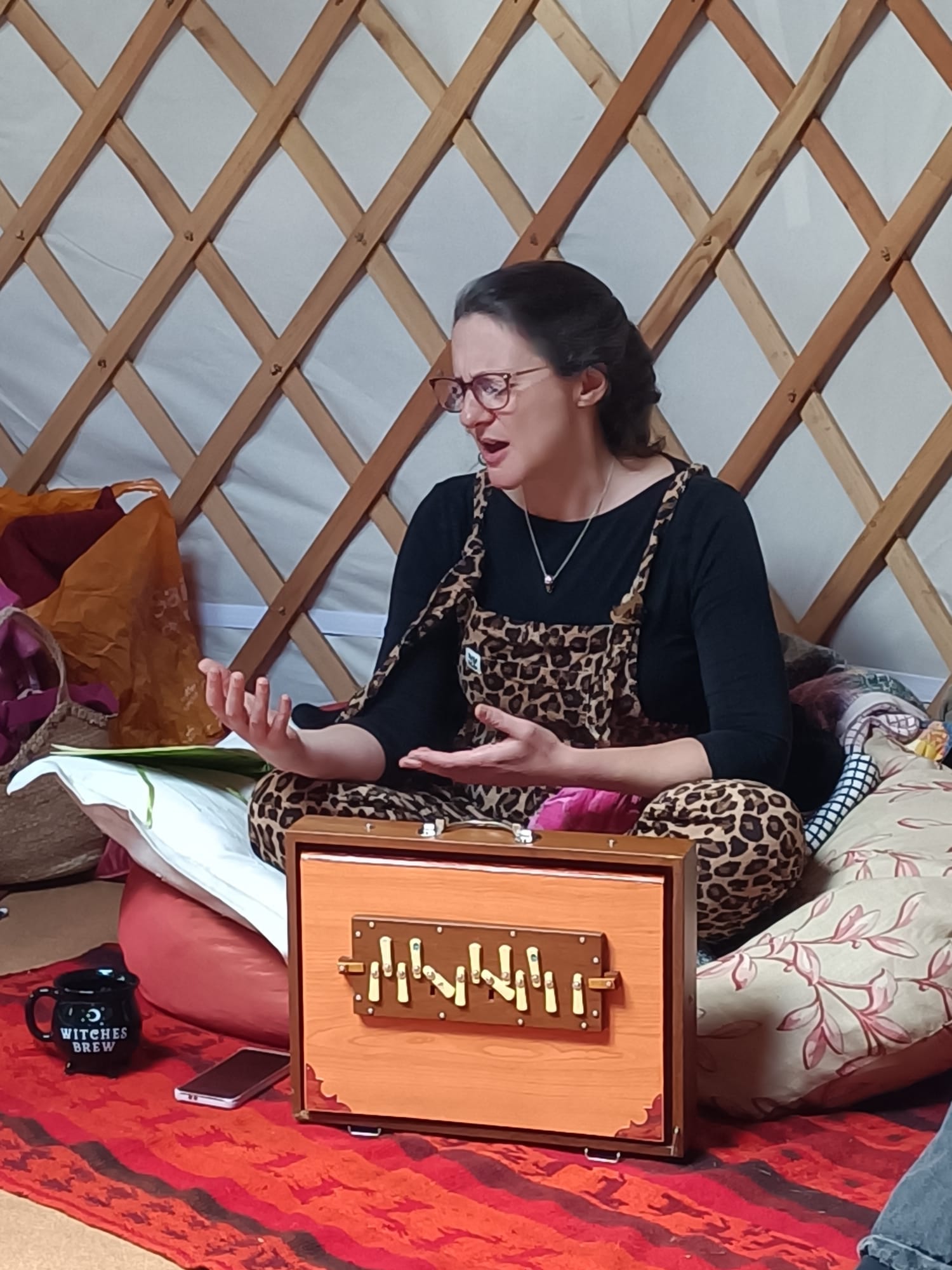
We speak with the stories, name moments that move us, respond to other people’s moments so that we are weaving a network of thought and dream. In these stories, says Abi, tender of the fire, transformation is normal. But we don’t live with these fluid, pulsing, moon-running story-dreams. We exist, instead, with stories of a toxic system, in which transformation is a curse we have to hide (like the shedding of our skins every month), or a shift we have to fight for and defend every moment we’re alive (like the ability to exist within our gender multitudes). Our transformations are not like Old Bet putting on her yellow cloak and walking down the road. Putting your thumb in your mouth to stop the burning. Riding out to market in the starlight, and keeping on going.
Stories are change-makers, memes in the corner of our minds, patterns in the ribbons of our DNA, nestling in the porous membranes of our cells. In a world which is in the midst of catastrophic transformation, how do we take change into us so that, each moment that we change, we offer out change to our rippling world? One of the ways the magic of transformation has been taken away from us is that we have been made to believe it as individualistic; if we must enact a fluidity, we should keep it to ourselves. But, like the change made by a nettle steeped in water or a rosehip falling onto a hill at dusk, change is what allows us to be world. These stories are stories that belong to us, and stories that medicine us as we realize this.
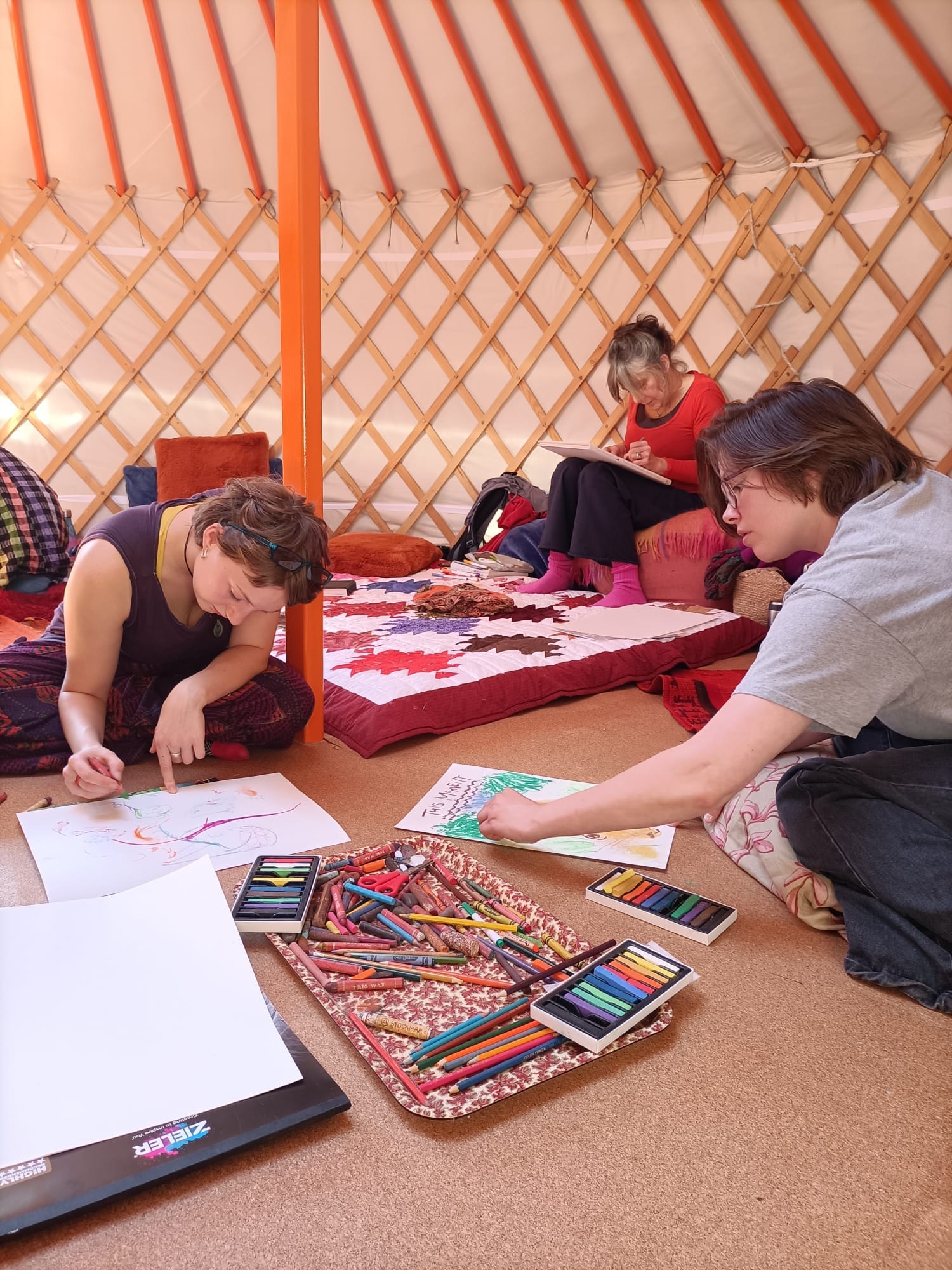
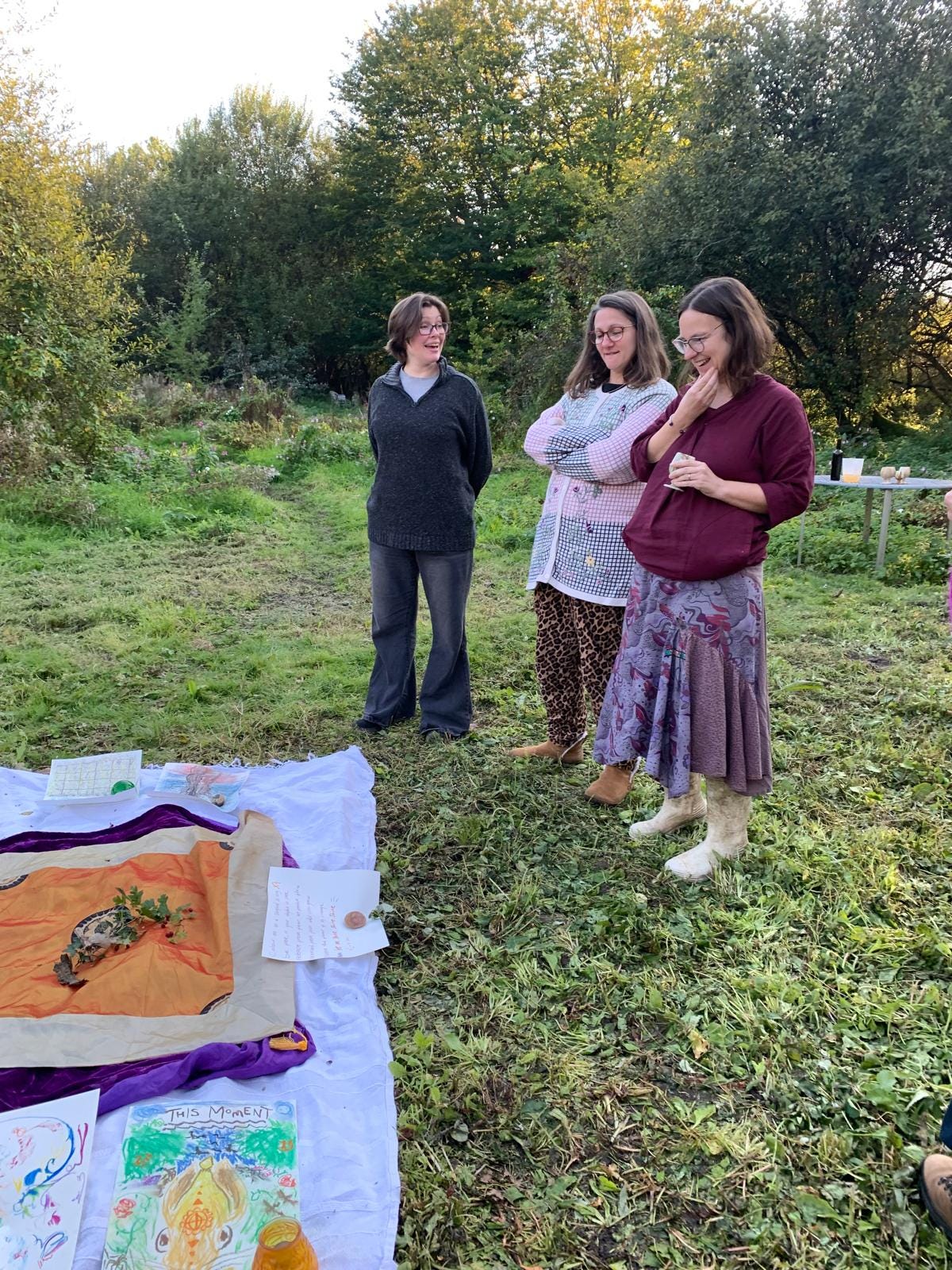
We speak, we draw, we sing, and, in the late afternoon, we make a witch-hare ritual in the field, surrounded by high poplars and deep willows. What it is for, we let emerge in the pattern of our voices and the patterning of the wind on the altar cloth. What it remembers, perhaps, is the sanctity of wild change.
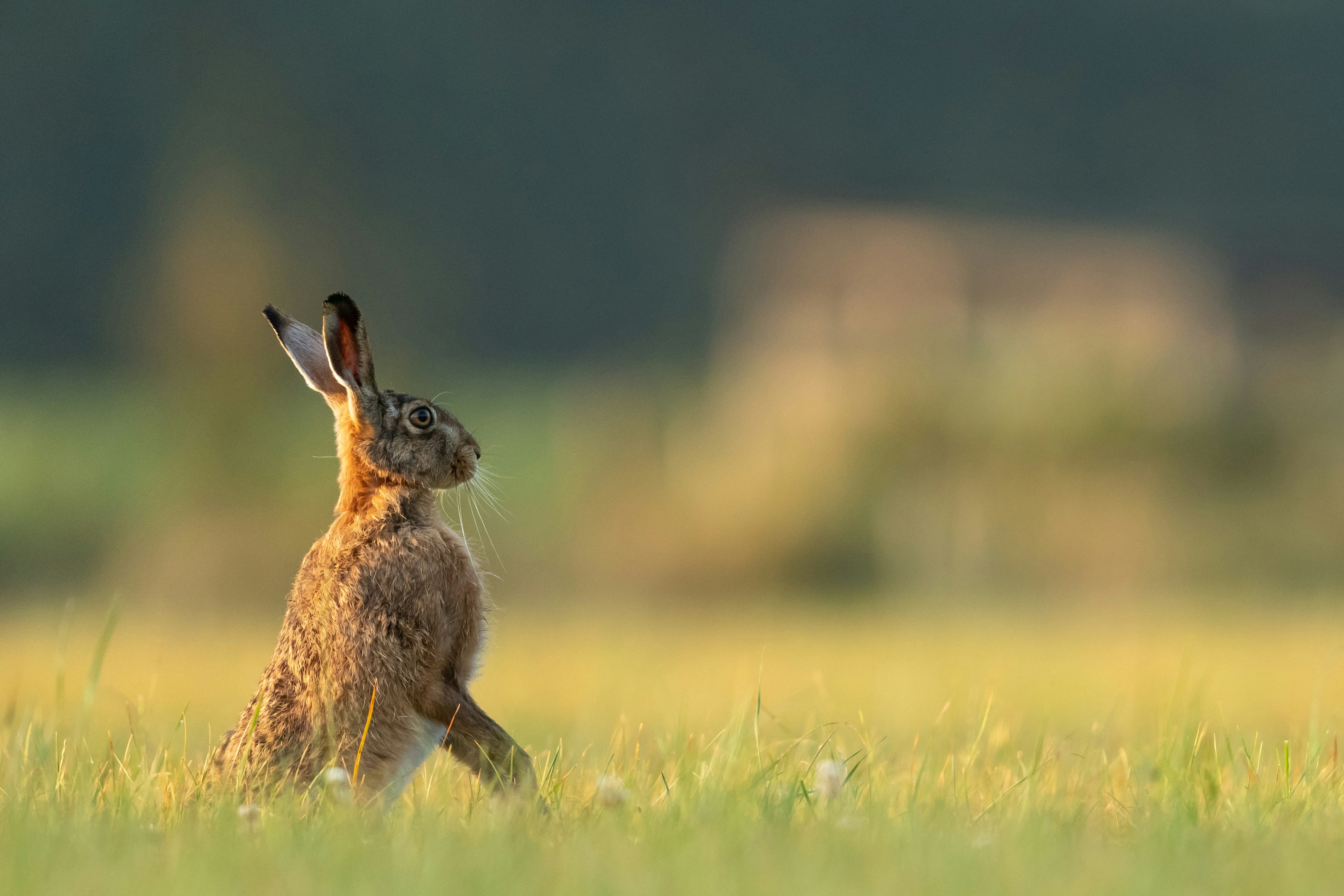
Thank you so much to the incredible storytellers who joined us, and to everyone who gathered together in our first witch hare space.
Unfolding Adventures
Our next witch hare session is a Samain session in Litlington, next to the Cuckmere River and beside the Seven Sisters, on October 27th. Sophie Gibson will tell the magical ‘Beekeeper and the Hare’, RunesnRoses will be sharing her incredible witch hare poem, and writer Sam Chittenden talking about her witch hare play ‘Sary’, set in the Cuckmere Haven valley. You can join us online for this, and we also have some in-person tickets left.
In December, Fleur Hemmings will guide us in a sauna storytelling session in Stanmer Sauna Garden, celebrating witch hares and wondrous bodies, with storytellers Stacia Keogh and Deb Winter, and ritualist Elizabeth Jane Lovely.
If you’d like to part of these wild witch hare adventures, get in touch.
Oh Joanna! So grateful you are sharing here and dearly hope to gather together again one day, in person this time... Blessed be these magical hare-y tales and thank you for the space you hold and the questions that quilt through them.
This was a wonderful workshop in your beautiful yurt. 'm so looking forward to co-facilitating the one this coming weekend in Littlington (and online for those who can't join us in person). Also, to join the one in December with Elizabeth Jane Lovely who writes Fairy Tale Apothecary