
To be small radical

It’s hard to wake up in the world right now, and hard to sleep in it. I think it’s hard to stand up to time. For too long, we’ve known that the rift between what is given and what we take is so great that it fractures the world. Only now, the fault-lines are closer. Fascism rises in places we had thought to trust, and cities that remind us of ourselves are burning.
How do we stand up to time? What do we do with it? Creative work feels empty, and yet at the same time, even more urgent. At an online conference back in October, Cristina Bacchilega and Pauline Greenhill were speaking about their book Justice in Twenty-First Century Fairy Tales and the Power of Wonder.1 Here, they explain that fairy tales are, often, stories of otherwise, stories that ignite our ability to live with difference and invite us into a world of plurality, of complex encounters with a human and more-than-human multitude.
That isn’t to say that fairy tales are idols from a golden age of truth and harmony. They are layered with the language and value systems from every time they have been written or told. They are embedded with the silt and grime of sexism, misogyny, racism, anthropocentrism but also, they are keening with interconnectedness of things and ringing with wonder.
In the conversation afterwards, we were talking about the warped reality we live in now. I said to Cristina and Pauline, are fairy tales, which acknowledge the livingness of things, more real than the way capitalist-consumerism would have us comprehend the world? Are they more real than the reality we live in? Perhaps, they said.
What does ‘real’ even mean, anyway? According to the etymological dictionary, the word shapes back to Latin, realis, ‘actual’, to Medieval Latin, ‘belonging to the thing itself,’ from res, ‘property, goods, matter, thing, affair.’ 2 Belonging to the thing itself. But what belongs? Is it the things that belong to us, or do we belong to them? Belonging, by the way, another interesting one, from different roots: the Old English langian, ‘pertain, to go along with.’ 3
So if we splice together these linguistic roots in a chaotic, multicultural word conversation, we could think about reality as going along with things.
In Meeting The Universe Halfway, theoretical physician Karen Barad explains that, if you look at the ‘real world’ closely, you cannot separate yourself from it. ‘Matter and meanings are not separate elements. They are inextricably fused together, and no event, no matter how energetic, can tear them asunder.’ 4 Things have as much power in creating reality as we do. It is, says Barad, in a book I recommend you read to alter your brain chemistry, the intra-action between the witness and the witnessed which makes up all the world.5
So perhaps to stand up to these times, we need to ignite our relationship to what reality is. To reach out towards a real that goes along with things, rather than abjuring them and existing in the vicious web-funnels of fascist and capitalist lies.
The world this month has been talking about the sign in the window, the story told by Czech playwright and president Vaclav Havel, and quoted in Mark Carney’s speech at the World Economic Forum. ‘Workers of the world, unite’, reads the sign in the window under the Communist system. Not because the shopkeepers believe it. But because the system demands that this is what the window says.
In a system in which we feel powerless, we still have a choice to take the sign out of the window.
Do we, though? We do if we have the resilience necessary to do so. There are times when to resist is just to keep ourselves alive, and existing in our breathing bodies in a world that doesn’t believe in them is a radical act in its own self, whatever our window glass says. Let’s remember that also.
If we were though, to have the capacity both to take the sign down and keep ourselves alive. What would we have, instead, in our windows?
Tiny places of real. They may not seem to matter. Maybe they do. Maybe, when you’re not able to put your body on the front line, to go along with matter is small radical. Or maybe it isn’t. Maybe it isn’t enough. Is there anything real about having the space, safety and privilege to engage in slow time with the livingness of things, when others are living in emergency time? I don’t know anymore. I don’t think any of us do.
Nevertheless. Here is a moment of real from my week. I’d love to know of the real in yours.
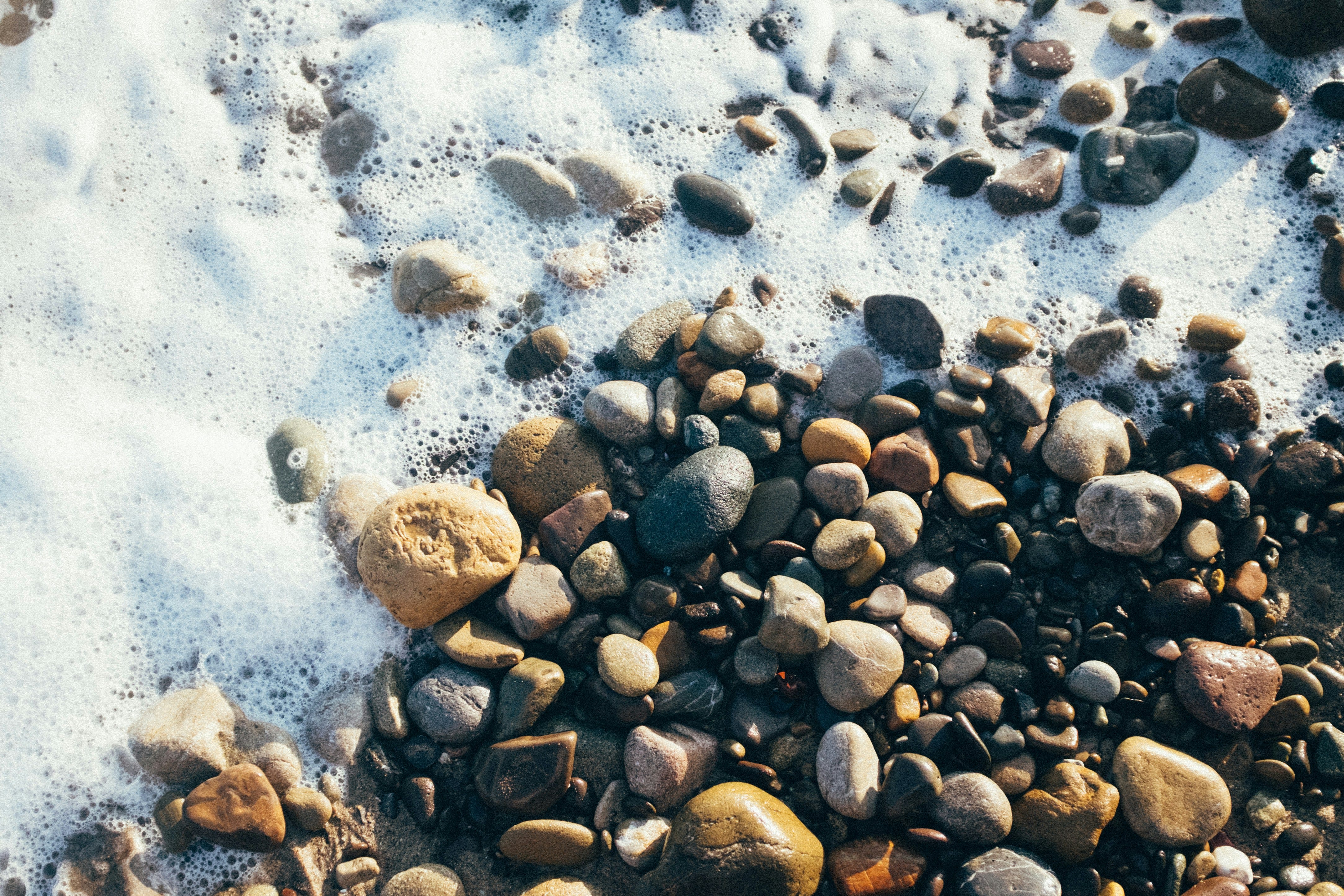
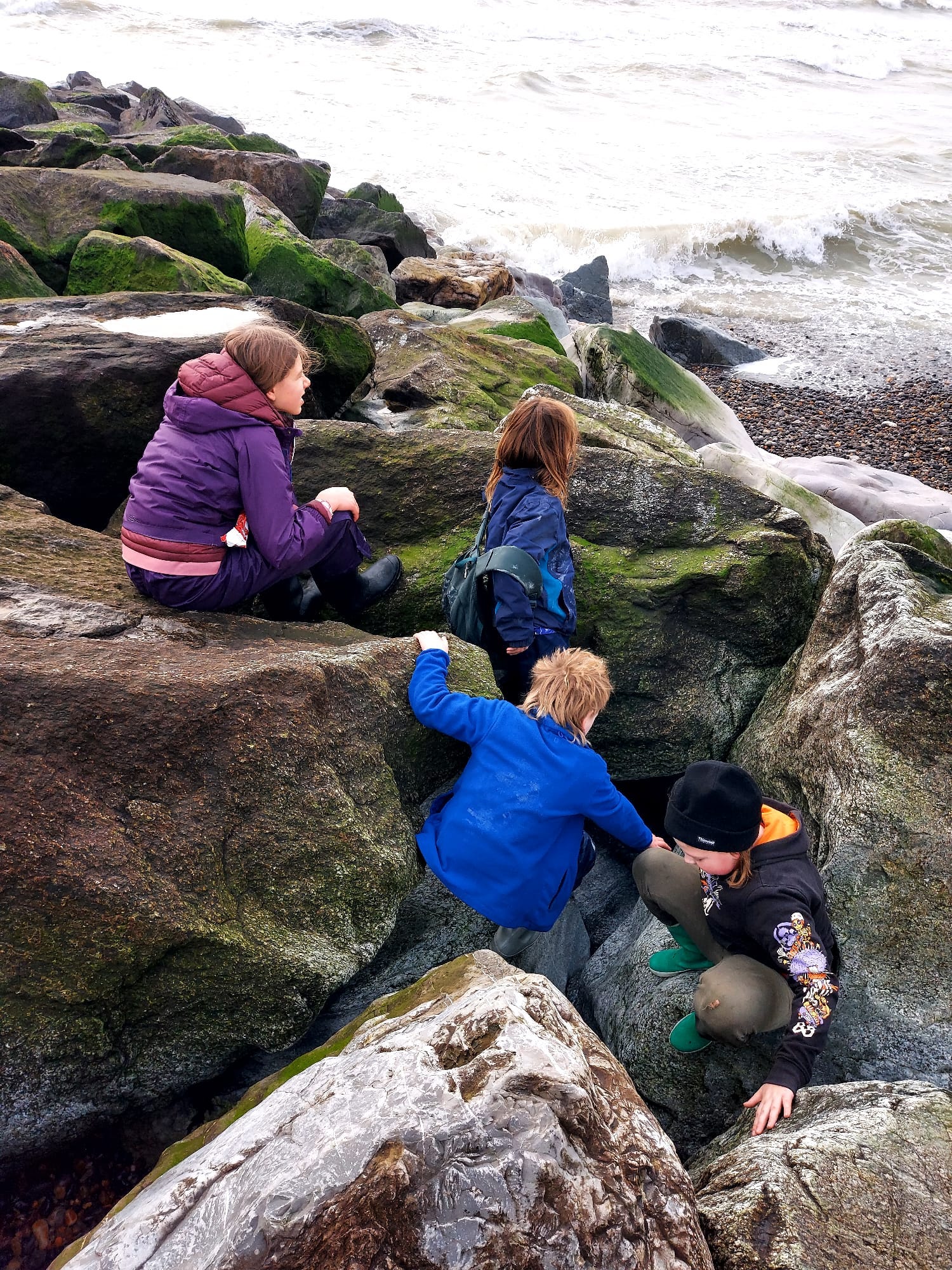
It looks like rain, but it isn’t raining yet. The colour of January greys and greens across the coastline. Pebbles meander alongside the potency of foam. Children are shouting. Some of them do their own thing in conversation with the sea, some of them watch over others, some of them kneel down with scissors, and snip at some of the seaweed, fronds against the rocks.
We’re learning about what seaweeds to forage. And oh, yes, there are complexities here, as there are everywhere. We disturb the limpets with our feet, though we try not to. Sometimes we accidentally tear the seaweed by the roots, though we mean only to clip, to trim, so that this ragged, porous, wild weed will keep the world breathing. We’re here because we have the energy and capacity to gather, to have a safe beach to gather in. It is real, yes. It is also exceptional.
The kids on the beach are all ages. They have a complexity of needs and schooling systems. But here by the sea they are all part of an amorphous, tentacular gang, streaked with chalk, wading with soaked limbs, collapsing on the pebbles. Looking for hag-stones. There is a pirate ship out at sea, say the nine and ten year olds. Look, there, at the flag! Are they coming to take over? If they are, say the adults, they might do a better job than what is growing here.
The kids know the pirate ship isn’t ‘real’. But oh, this salt-streaked, wet threat so much more real than screen doom. If the pirates come, we are together, the pebbles and the seaweed and the blobs of us, watching for what next.
And after we have foraged, our hands raw with saltwater, we sit on the rocks, snack, clamber and climb and the adults vaguely try to prevent broken limbs and I think, I don’t want to talk to humans right now. So I go and stand next to Felix who isn’t very chatty but who is immersed throwing stones into the sea, and he throws stones into the sea and I throw thoughts into the sea, and we stand side by side like that, as the tide comes in.
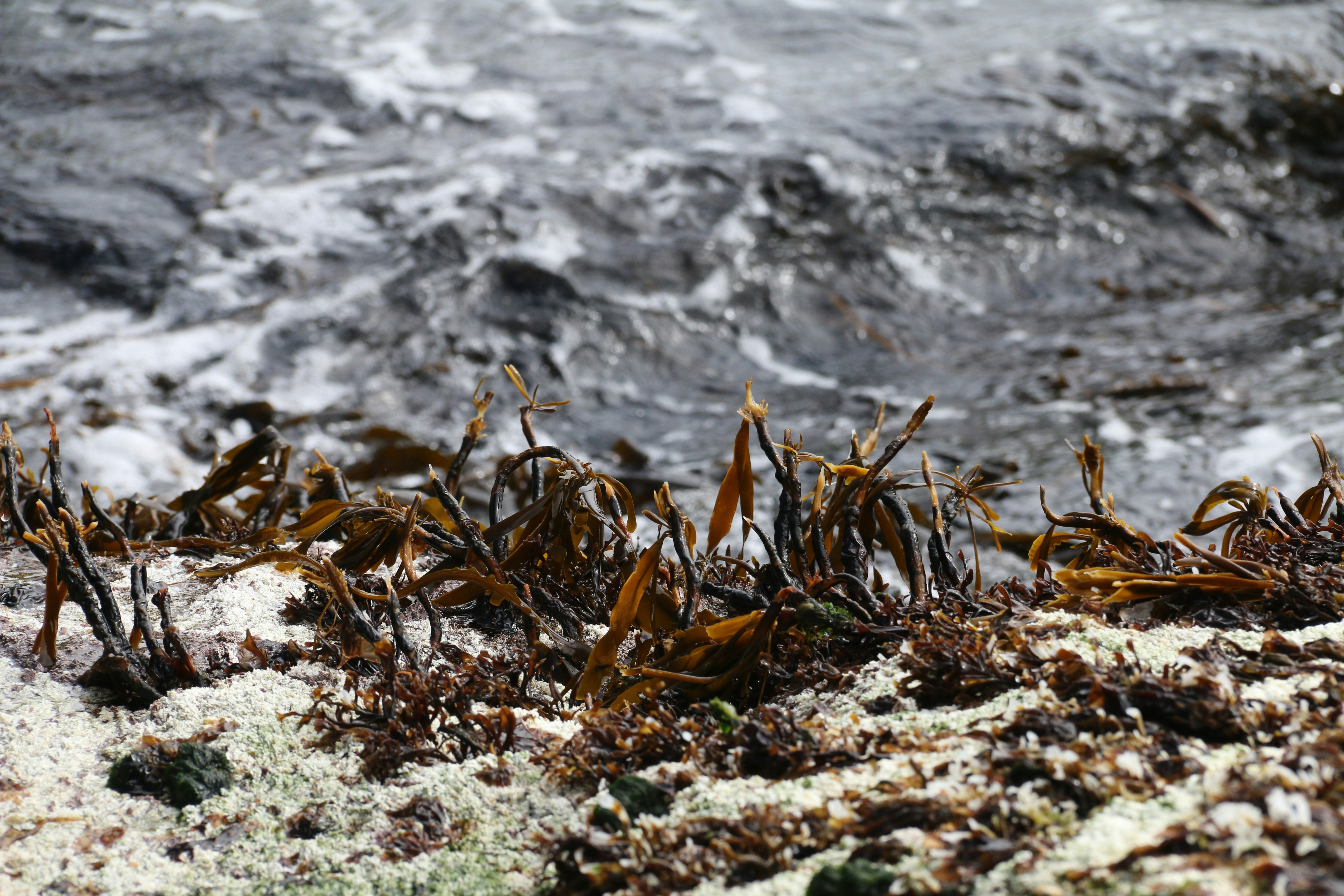
At Christmas time, we were talking about what would happen if war breaks out, and whether we have emergency supplies; how many tins of food, how many gallons of water. We had this for Covid, we don’t now, and I think we should. But here, beside the sea, this is also preparation. Hoarding is preparation. So is witnessing. That the popping bladderwrack, the pulsing dulse, the drifting wireweed, the bands of kelp and the green threads of gutweed, are all edible, if gathered safely, sustainable, if gathered carefully, and also, flush our bodies with minerals, vitamins and antioxidants.
Supermarkets splice reality in under-the-surface ways, they depend on multitudes of impact we cannot see, and they are not reliable in crises. Seaweed is right here. And the space we consume so that we can consume it is the space we own, right there in the moment. Us, seawater, damp blades, wet hands.
There is a quote I read once which sings at the back of my mind. Apologies that I don’t remember the source (if you know it, let me know). It’s from an Indigenous teacher, and the idea is that, if you know, in the land around you, what you can eat and what can heal you, then you won’t get lost. How could you? But we are lost, today, immured in the unreality with which the systems bind us. Our anchor roots are screens, which make no soup, or bandages, or oxygen, when the air is tight and the lights go out.
Here is small radical, then. Breathing on the clogged-up windows, sticky with residue from signs that no longer make sense, and trying to let the world through. From matter to matter. From eye to eye. From heart to hand.
The sea moment
for just a moment,
we don’t come with guilt
disruption drift
and crackling
from our pores
for just a moment we are
shore and silt
the ragged pounding moment
where we pour
our compass mind
like balm across the sand
and we are only green, and gilded green.
our breath the colour of the rising foam
for just a moment, we are cliffs and planes
quick riders on the rhythm of the raw
light; soles upon the stones
our hearts the chalk unknown
for just a moment
we are driftwood
sea-horse
in our own palatial
homes
1: Justice in Twenty-First Century Fairy Tales and the Power of Wonder. Cristina Bacchilega and Pauline Greenhill. Bloomsbury Academic, 2025.
2: Online Etymology Dictionary: https://www.etymonline.com/search?q=real
3: Online Etymology Dictionary: https://www.etymonline.com/search?q=belong
4: Karen Barad, Meeting the Universe Halfway, 2007, 3.
5: In Barad’s words: ‘A phenomenon is a specific intra-action of an “object” and the “measuring agencies”, the object and the measuring agencies emerge from, rather than precede, the intra-action that produces them.’ Meeting the Universe, 128.
Thank you for bringing us along on your seashore journey. I could feel the salt in my mouth and the sand between my toes. I do not fear the world, or the changes that may come to humans. I do grieve the loss of the bees, trees, and living stories.
“the land knows you, even when you are lost.” - Robin Wall Kimmerer (Braiding Sweetgrass).
Beautifully expressed Jo - There is balm here which is needed in these unsettling turpid times.